A selection of sunrises and landscape photos from the local birding patch at East Halton/Goxhill.

 |
| East Halton Beck. |

 |
| East Halton Marshes Mitigation Area. |

 |
| Winter's Pond Sunrise,East Halton. |


 |
| Humber Sunrise,Looking Towards Killingholme Haven. |

Welcome To My Blog,This Will Be Mainly Used As A Diary For My Local Birding Patch At East Halton/Goxhill On The Banks Of The Humber Estuary,With Occasional Twitching And Visits Elsewhere Including Photos From Mine & Tracey's Walks And Holidays Around Our Beautiful Countryside.
A selection of sunrises and landscape photos from the local birding patch at East Halton/Goxhill.
|
| East Halton Beck. |
|
| East Halton Marshes Mitigation Area. |
|
| Winter's Pond Sunrise,East Halton. |
|
| Humber Sunrise,Looking Towards Killingholme Haven. |
In 2017 i heard with understandable excitement that a new wetland area was to be created between Winter's Pond and East Halton Skitter on my local birding patch at East Halton on the banks of the Humber Estuary in North Lincolnshire.
The area is being created for mitigation in replacing lost habitat elsewhere on the Estuary due to industrial developments and in turn loss of habitat for mainly,wading birds.
So began the work by contractors on behalf of Able UK and all the hedges were removed and then a series of interlinking shallow channels excavated in the ground to collect rain water and then in turn flood the surrounding area in the hope this would provide breeding and roosting habitat for waders and also wildfowl.
Unfortunately the creation of this area has had mixed success,with lack of proactive management and at times very little water being on the site and also the vegetaion which has grown up,being far too high for waders or wildfowl to take advantage of the feeding areas.
All is not bad though,as this winter has seen a substantial flock of sheep introduced to the site and this in turn has created some great conditions along with the large amount of rain causing flooding and in turn making great feeding conditions for several wader species which included a flock of 500 Dunlin,2000 Lapwing,300 Golden Plover and smaller numbers of Curlew,Redshank and even Turnstone.
The area has also attracted some decent numbers of passerines,with flocks of Linnet,Goldfinch and smaller numbers of Reed Buntings being present and we have also had some large numbers of winter Thrushes visiting the site,particularly Fieldfare,plundering the remaining Hawthorn Hedgerows for the abundant berry crop.
Another couple of rarer visitors to the site have included Water Pipit and Waxwing.
Raptors have found the site particularly good for hunting with regular Marsh Harrier,Kestrel,Common Buzzard and Sparrowhawk sightings,with Peregrines also becoming a more regular sight also.
Rarer raptors have included Hen Harrier,Merlin and Red Kite.
Those close relatives of Raptors,Owls,have proved regular visitors,with sightings of hunting Barn Owls on most days and also in most winters,we also have the lovely Short-eared Owl also using the site,visiting us mainly from Scandinavia.
Up to the time of writing a total of 20 species of waders have been recorded on the site by myself,which have included such niceities as Wood Sandpiper,Avocet,Greenshank,Whimbrel and Ruff.
Wildfowl visitors have included regular Whooper Swan visits in both autumn/winter and spring periods and large flocks of the wintering Pink-footed Geese from their roost sites on the estuary,make regular flights over and sometimes onto the site.
The rarest wildfowl visitor so far has been 2 Russian White-fronted Geese seen with the regular,local Greylag Goose flock on 5th January 2020.
The rarest visitor observed on the site so far,occurred on the 3rd April 2018,when i discovered a singing male White-spotted Bluethroat singing in a reed filled ditch on the very southern edge of the area.The bird showed on and off for the whole of that day,but was gone on the next.This species is a breeding bird as close as the Netherlands in Europe and will have been blown off course on its migration there,from North East Africa were this species spends the winter months.
As a whole the site has proved attractive to the Chat family,of which Bluethroat is a member along with our commoner Robin and other species observed have included regular Wheatear,Redstart(1 female,11th September 2020),Whinchat(14 on the 23rd August 2020),Stonechat(8 on the 7th October 2020) and a female Black Redstart on 16th March 2020.
In all i have recorded a total of 126 species of birds so far on and over the site,which is pretty good in 3 years.
The site has also proved attractive to mammals,with particularly Roe Deer being seen on a regular basis along with occasional Fox and Brown Hare sightings,with lots of Badger prints being found all over the place,but i'm still yet to see one in the flesh.
Insects have included a profusion of interesting species which have included Lesser-marsh Grasshopper,Roesel's-bush Cricket,Emperor and Southern-hawker Dragonflies and at least 11 species of Butterfly.


 |
| Male Roesel's-bush Cricket. |
 |
| Lesser-marsh Grasshopper. |
 |
| Male Emperor Dragonfly. |
 |
| Peacock Butterfly. |
 |
| Buck Roe Deer. |
 |
| Juvenile Whinchat,With A Reed Bunting. |
 |
| Male Stonechat. |
Another chance today to get out locally with Mrs R,walking again from home due to the continued travel restrictions,saw us today walking from Barnetby up to Melton Ross and then onto New Barnetby up to Bigby Top and home,covering approximately 8 miles.
The weather today was cold again as on our last local outing,but today was a cloudier affair,but still enjoyable all the same.
Some nice birds were encountered and included a pair of Stonechat in their usual set aside field bewteen Barnetby and Bigby and some impressive numbers of wintering Buntings up on the Wolds between New Barnetby and Bigby Top,which included a flock of 40 Corn Buntings,16 Reed Buntings and 72 Yellowhammer.
The temperature today stayed below freezing providing us with some frosty landscapes to photograph along with the plants along the walk being in a deep freeze also,displaying various amounts of ice crystals on their leaves making for some great photo subjects.
The following are a selection of photos from the walk and we are both looking forward to our next local wander.
Frozen Landscape Near New Barnetby. 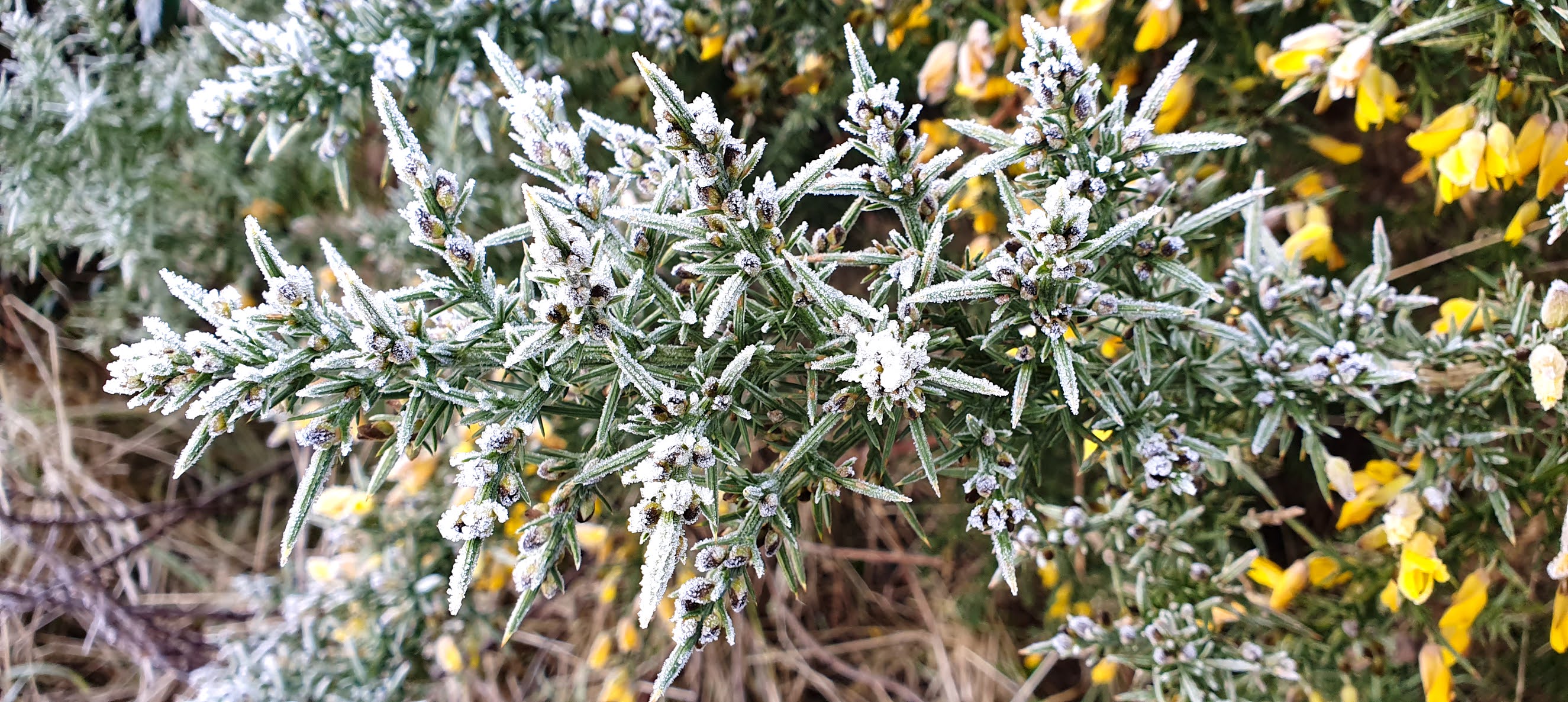
The Lovely Gorse Covered In Frost.

 |
| Frozen Knapweed Heads,Covered In Ice Crystals. |
 |
| Frozen Fields At Bigby Top,With The Ancholme Valley In The Distance. |
 |
| The Humber Bridge Photographed From Bigby Top. |
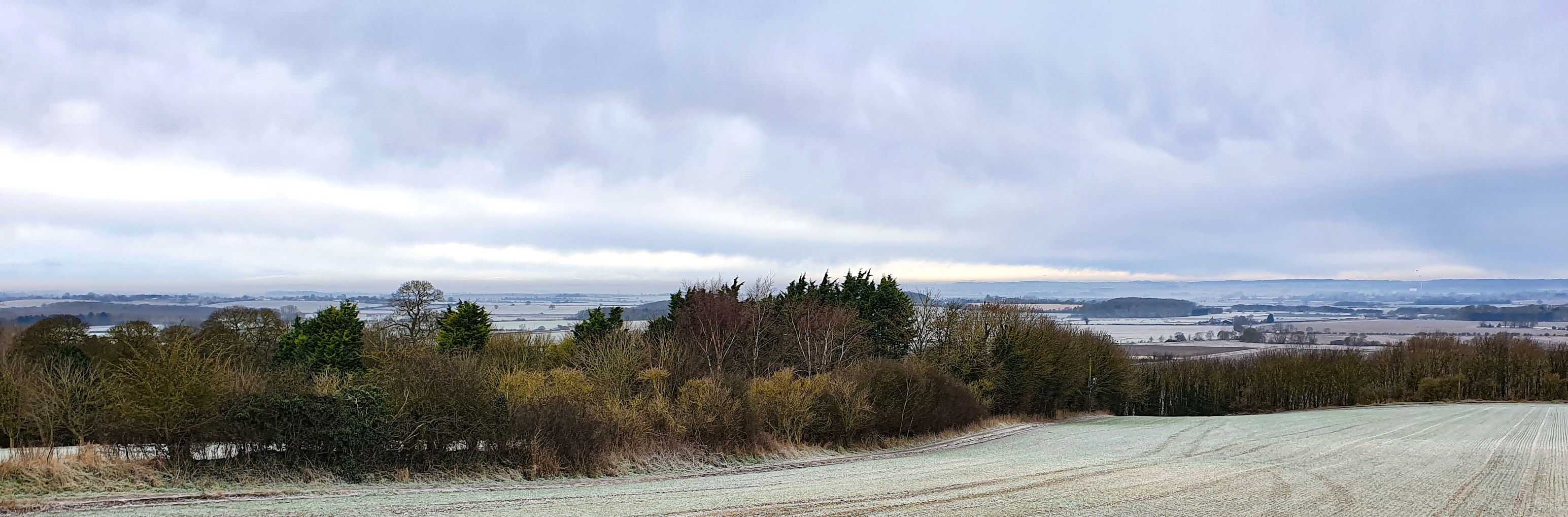 |
| Bigby Top And The Ancholme Valley. |
 |
| Roe Deer Footprint Near Bigby Quarry. |
 |
| The Frozen Ancholme Valley,Looking Towards Howsham. |
With the prospect of a great forecast today,albeit a nippy one,Tracey and myself walked from home along part of the Viking Way long distance footpath Up To Owmby and back.
The weather was superb all day and it was really nice to walk along here again,particularly the lovely wolds villlages along the journey,my favourite being the lovely little hamlet of Somerby.
A few nice wildlife and bird encounter's included a pair of Stonechat just outside of the village at Barnetby,a lovely Nuthatch at Somerby,my first of the year and some Seven-spot Ladybirds found hibernating on some Great Mullein stems at Searby.
To be perfectly honest it was just great to be out walking together again,with this lock down and Covid 19 not looking like it is going to be going away for a long time yet.
The following are a selection of photos from our walk.
 |
| Mrs R At Bigby. |
 |
| The Viking Way,Bigby. |
 |
 |
| The Viking Way Between Bigby & Somerby. |
 |
| The Grade ii Listed Monument Dedicated To The Marriage Of Edward And Ann Weston Overlooking Somerby. |

 |
| St.Margeret's Church,Somerby. |
 |
| The Viking Way Between Searby And Owmby. |


 |
| Hazel Catkins,Owmby. |
 |
| Seven-spot Ladybirds On Great Mullien. |
 |
| The Church Of St.Nicholas,Searby. |
 |
| The Viking Way,Searby. |
 |
| Ivy,Somerby. |
 |
| The Church Of All Saints,Bigby. |
New Year's Day
As is tradition in birding circles,i began the new year with a full day on the local patch attempting to see and hear as many species as possible during the 9 hours i was on site.
The first new species of the year went to Blackbird,while listening and searching for Owls and Woodcock in the dark.This might sound crazy,but it did pay dividends with 3 singing male Tawny Owls being located and also a much sought after Little Owl calling at East Halton Grange.
I then made my way around to Winter's Pond and waited for it to get light,again listening for more calls to add.
As it got light,Winter's was again the place to be with several good birds to bring in the New Year with.
Highlights included the semi-resident 1st winter male Scaup,a pair of Goosander and a lone adult Whooper Swan,the latter no doubt the solitary adult bird i have recorded here over the last 3 consecutive winters.
Other birds here included a whopping site count of 28 Mute Swans,the most i have recorded and a new personal species for the site,a Treecreeper seen along the main hedge down to the Humber floodbank.
The usual suspects were seen around the Skitter and i happily added both Water and Rock Pipits to the year list,a flock of 40 Black-tailed Godwit and a male Stonechat.
A walk up to Dawson City saw the best birds including 3 each of Marsh Harrier and Common Buzzard and on the Humber at least 12 Common Scoter were still present with the Goldeneye flock.
After lots of effort today,i ended up on a very decent total of 86 species,with common species such as Cetti's Warbler,Barn & Short-eared Owl missing.
A really pleasing start to the new year list and i was looking forward to the next chapter.
3rd January
I started as always today at Winter's again,where else,as it keeps turning up some nice birds and there are always plenty of Wildfowl on show.
Today was no exception,with again,the 1st Winter male Scaup being present,the pair of Goosander here again and 2 year ticks in the form of Cetti's Warbler and Kingfisher.The Cetti's was the resident territorial male and only heard blasting out that distinctive song,the King on the other hand showed nicely as it caught a fish and then proceeded to batter it for a few minutes before enjoying its well earned breakfast.
I then decided to walk down the Mitigation area,when the first of the days rain passed overhead.It did provide some great photo oppertunities though,with some cracking rainbows.
To be fair,due to the rising water levels on here,there were a lot of birds using the site and included a single Water Pipit,860 Lapwing,9 Redshank,10 Snipe,a 1st calendar year Marsh Harrier and 3000 Starling.Also observed on the site and adjacent fields were 9 Roe Deer giving their usual brilliant views.
The Skitter area was again pretty productive for waders,with a good count for the time of year of 264 Black-tailed Godwit,also here were 720 Dunlin,3 Rock and 3 Water Pipit,22 Snipe and an adult female Marsh Harrier.
After the Skitter,i put in some serious effort to try and find a Jack snipe,walking along the saltmarsh up to Dawson City,with no reward unfortunately,but sightings included 2 more Rock Pipit,7 Snipe,7 Common Scoter and on the landward side of the floodbank,2400 Pink-footed Geese and a Treecreeper were seen.
A good look through the Pinks unfortunately didn't reveal any other species mixed in with them.
As the tide dropped off,more waders became more obvious and 4 Grey Plover,18 Knot,500 Dunlin and 34 Ringed Plover were logged.
As the rain had set in,with it drizzling on and off all the way back to Winter's it was less than an enjoyable walk back,but after reaching Winter's for the second time today,it was nice to see the Goosander pair at relatively close range as they fished for their supper.
A great couple of visits,with me on 88 species for the year and i'm looking forward to my next outing here.
 |
| Incoming Storm Clouds Over The Humber. |
 |
| Another Stunning Rainbow. |


